If your service business feels like it owns you, you're not alone. So many entrepreneurs hit a wall where the only way to grow is to work more hours, take on more stress, and basically clone themselves. But the answer isn't about working harder—it’s about fundamentally changing how your business operates.
Making that leap from a hands-on founder to a strategic CEO is the single most important transition you'll ever make.
Moving From Founder to CEO in Your Service Business
This journey really begins with a new way of thinking. As a founder, your value is tied directly to your skills and the hours you put in. You're the one delivering the work. As a CEO, your value comes from the systems you build and the team you lead. It's the difference between creating a high-paying job for yourself and building a real, valuable asset.
The Myth of Constant Hustle
Let's be honest: the "hustle culture" we see glorified everywhere is a trap. While hard work is part of the game, true scaling comes from leverage, not just more effort. Right now, you are the biggest bottleneck in your business. When you are the business, you can't step away for a vacation or even a sick day without everything coming to a screeching halt.
The goal isn't to add more hours to your day. It's to systematically remove yourself from the day-to-day delivery so the business can run without you. You need to build an operating system that delivers amazing results, whether you're at your desk or on a beach.
This guide is your playbook for building that operating system. We're going to walk through, step-by-step, how to get you out of the daily grind and into the driver's seat. For a deeper dive, our guide on how to stop giving direct service in your coaching or consulting business is a great next read.
The 5 Pillars of a Scalable Service Business
To build a business that can truly scale, you need a solid foundation. Instead of getting overwhelmed by trying to fix everything at once, we're going to focus on five core pillars. These are the load-bearing walls of your company.
This framework gives you a clear roadmap for building a self-sustaining operation, piece by piece.
The 5 Pillars of a Scalable Service Business
| Pillar | Core Objective | Key Focus Area |
|---|---|---|
| Offer | Create one high-value, repeatable solution. | Productize your service to ensure consistent delivery and clear outcomes. |
| Team | Build a small, empowered group of specialists. | Define roles and delegate tasks with clear systems and accountability. |
| Operations | Systematize and automate client delivery. | Document workflows and use technology to create a seamless client experience. |
| Marketing | Master one or two channels to attract ideal clients. | Create consistent visibility and establish authority in your niche. |
| Sales | Install a predictable client acquisition process. | Build a repeatable system for qualifying leads and closing deals. |
Getting these five areas right is what separates the businesses that stay small and founder-dependent from the ones that grow into scalable, valuable assets. We'll be using this structure to guide our entire plan.
Defining Your Single Point of Focus
If you’re trying to fix everything in your service business at once, you’re on a fast track to burnout. I’ve seen it happen countless times. Real, sustainable growth never comes from scattering your energy across a dozen different "priorities."
The secret is to find the one thing that, if you nail it in the next 90 days, will have the biggest ripple effect across your entire business. This means getting way more specific than "make more money." A true strategic objective sounds less like "grow revenue" and more like "cut client onboarding time by 40%" or "get 25% more qualified sales calls on the books."
This single point of focus is your North Star. It’s the lens through which you’ll make every decision. And to find it, you first need to get brutally honest about what’s holding you back.
Every service business has a primary bottleneck—one dominant constraint that’s capping its growth. Your job is to find it. This is how you evolve from a founder who’s stuck in the business to a CEO who’s building on it.
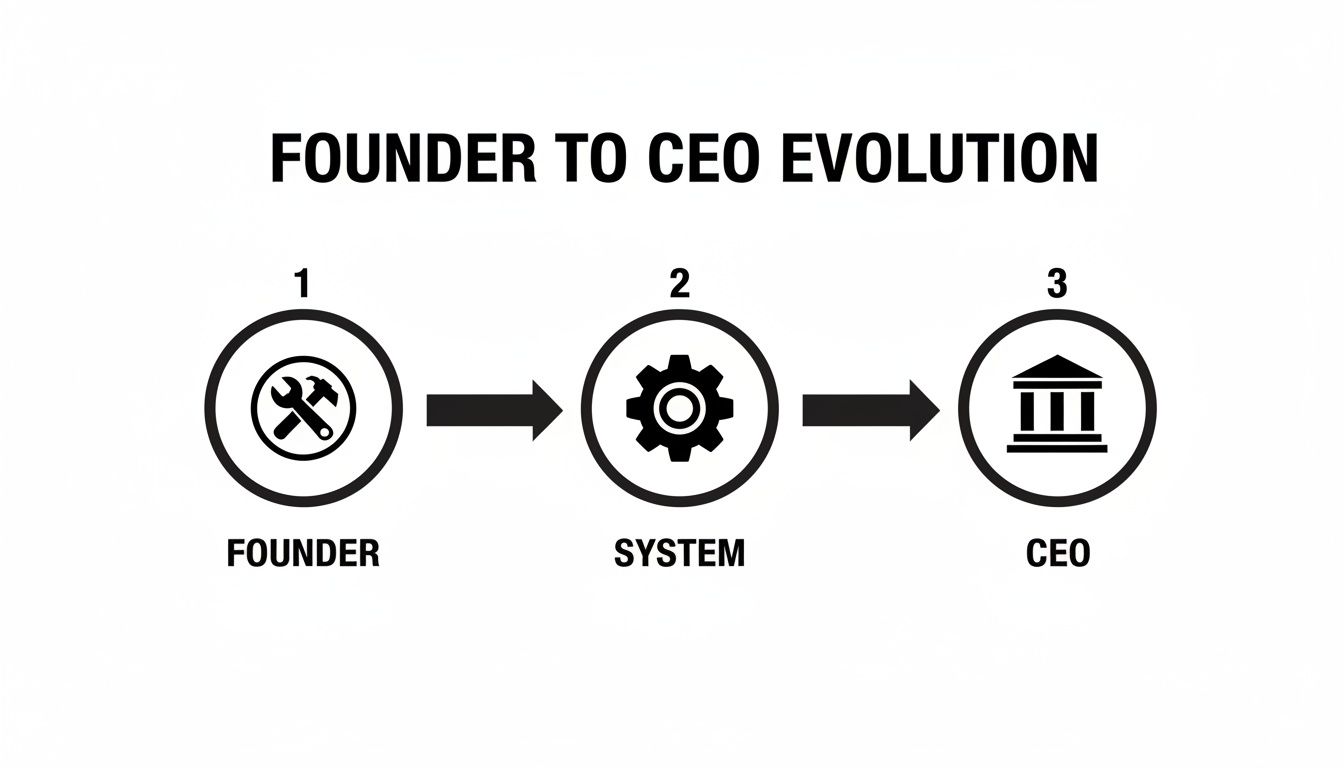
As you can see, systems are the bridge. They're what turn a founder's hands-on effort into a scalable, CEO-led operation.
Pinpointing Your Primary Bottleneck
Let's start with a frank assessment. Where does the most friction exist in your business right now? Most problems I encounter with service businesses fall into one of three buckets. Figure out which one describes you best, and you’ll be on your way to a focused objective that solves the real problem.
Take a look at these common scenarios—see which one feels familiar:
- The Overwhelmed Deliverer: Your calendar is jammed with client work. You have zero time for sales, marketing, or even thinking about the future. You are the service, and you've hit your personal capacity. Your bottleneck is likely in your Offer or Team.
- The Inconsistent Marketer: You live and die by referrals. One month is a feast, the next is a famine. Your lead flow is a complete mystery. Your bottleneck is almost certainly in Marketing or Sales.
- The Disorganized Operator: Every new client feels like starting from scratch. Onboarding is a mess, projects are chaotic, and you’re constantly putting out fires. Your biggest bottleneck is your Operations.
Think of a bottleneck as the skinniest part of the pipe. You can try to force more water through the front, but it won't matter until you widen that narrow section. If you're at max capacity delivering for clients, generating more leads will only cause you to drown.
From Bottleneck to Measurable Objective
Once you have a general idea of where your bottleneck is, it’s time to sharpen it into a clear, measurable goal. This isn't about guesswork; it's about a quick, honest self-assessment.
Answer these questions to see which area needs your attention the most.
Self-Assessment: Find Your Focus
1. Fulfillment Issues (Offer & Team)
- Are you personally delivering more than 50% of the client work?
- Do you feel like you can't hire anyone because the process is all in your head?
- Is "scope creep" killing your profit margins and burning out your team?
- Example Objective: Productize our core service into a clear package with three defined tiers by the end of Q2.
2. Delivery & Process Issues (Operations)
- Does it take more than five manual steps to get a new client started?
- Are key delivery tasks undocumented, leading to inconsistent quality?
- Are clients constantly asking "what's next?" because your process is unclear?
- Example Objective: Create a templated project plan in our project management tool that cuts client setup time by 30% in the next 90 days.
3. Growth Issues (Marketing & Sales)
- Are you having fewer than five qualified sales conversations each week?
- Is your main source of new clients just "random referrals"?
- Do you lack a repeatable process for turning an interested lead into a paying client?
- Example Objective: Implement a lead qualification system and discovery call script to boost our proposal-sent rate from 40% to 60% this quarter.
Choosing just one of these objectives is the single most important move you can make to scale your business. It's not just a goal; it’s a filter. From now on, before you or your team start any new task, you’ll ask: "Does this help us achieve our objective?" This simple question brings clarity, alignment, and an incredible amount of focus.
Productizing Your Offer and Building Your Core Team

Alright, you’ve got your North Star—that single, clear objective. Now it’s time to build the two engines that will actually get you there: your offer and your team. These are the pillars that create real leverage. Without them, you're not a business owner; you're just a highly skilled freelancer trading time for money.
Let's start with the service itself. Most service businesses stay small because the entire operation hinges on the founder's time and talent. To truly scale, you have to disconnect your revenue from your personal hours. That’s where productizing comes in.
Turning Your Service Into a Scalable Product
Productizing doesn't mean you have to create an app or a digital course. It’s all about packaging your expertise into a standardized, repeatable solution that delivers a predictable result for a very specific type of client.
This means you stop creating custom proposals for every lead that comes your way. Instead, you develop a signature service with a defined scope, crystal-clear deliverables, and a fixed price. The conversation shifts from "So, what do you need?" to "Here is how we solve your problem."
For instance, a marketing consultant who once did "a bit of everything" might productize their offer into a "90-Day Content Authority Engine." This package isn't a buffet; it’s a set menu with specific, non-negotiable inclusions.
- Month 1: A deep-dive content audit and a keyword strategy roadmap.
- Month 2: The creation of 12 foundational blog articles and a full set of social media templates.
- Month 3: A content distribution plan and the setup of performance reporting dashboards.
See the difference? This approach transforms a vague, custom service into a tangible asset. It becomes easier to market, easier to sell, and—most importantly—easier to hand off to someone else.
The real power of a productized offer is clarity. When clients know exactly what they’re getting and your team knows exactly what to deliver, efficiency skyrockets and scope creep disappears. You stop selling your time and start selling a guaranteed outcome.
This clarity is more important than ever. The global Business Services Market is on track to hit $1,380.6 billion by 2032, fueled by entrepreneurs who are desperate for clear, reliable solutions. In this environment, the service firms that nail one powerful, productized offer are the ones that see massive growth, simply because clients crave simplicity and predictable results.
Making Your First Critical Hires
With a standardized offer, you finally have something you can teach someone else to deliver. This is the magic moment when you can start building a team that doesn't just support you but actively grows the business for you.
Your first hires should be a direct attack on your biggest bottleneck. Their job is to free you up for the high-value CEO tasks: sales, strategy, and steering the ship. Don't fall into the trap of trying to hire a clone of yourself. Instead, hire for specific roles that fill your weaknesses or take over the tasks you shouldn't be doing.
A common mistake is waiting until you're completely underwater to hire. Be proactive. The second you have a documented process for a task that’s eating up more than five hours of your week, it's time to seriously consider delegating it.
Who Should Be Your First Hire?
The right first hire depends entirely on where you're feeling the most pain. Here’s a simple way to think about it:
| If your bottleneck is… | Your first hire should be a… | Their primary role is to… |
|---|---|---|
| Client Delivery | Junior Technician or Specialist | Execute the core tasks of your productized service using your documented system. |
| Administrative Chaos | Virtual Assistant (VA) | Handle scheduling, invoicing, email management, and client onboarding logistics. |
| Inconsistent Leads | Marketing Coordinator | Manage your chosen content channel, schedule posts, and track engagement metrics. |
| Sales Process | Sales Development Rep (SDR) | Qualify inbound leads, book discovery calls, and manage the CRM pipeline. |
Hiring is tough, no doubt about it. But it's also one of the most rewarding parts of scaling. If you're looking for a deeper tactical approach, check out our guide on building your hiring team with no fluff, just results.
The goal isn't to build a massive team overnight. It's to make one or two strategic hires who can take ownership of key functions, letting you focus on the next growth lever. A refined offer plus a small, empowered team creates the momentum you need to smash through any growth ceiling.
Creating Repeatable Systems for Client Delivery
Alright, you've got a killer offer and a solid team. Now it’s time to build the operational backbone that holds it all together. This is where we create the predictable, repeatable systems that make client delivery smooth and scalable.
Without these systems, every new client feels like you're reinventing the wheel. Quality becomes a coin toss, and you, the owner, are stuck putting out fires instead of growing the business.
The whole point is to design a client experience so consistent that it feels five-star every single time, no matter who on your team is running the show. This isn't just about making clients happy; it's about building a business that can finally run without you being involved in every little detail.
Mapping Your Core Client Workflow
First things first: you have to get the process out of your head and onto paper. We need to map the entire client journey, from the moment they sign the contract to the final project handoff. This becomes your master blueprint for getting results.
Don't overcomplicate this. Seriously, just grab a whiteboard or open a Google Doc and list every single step.
- Onboarding: What exactly happens right after they pay? This is your chance to make a great first impression. Think welcome kits, scheduling the kickoff call, and gathering all the info you need from them.
- Kickoff: What's the agenda for that first official meeting? Nail this down. You need to define the goals, set clear expectations, and get everyone aligned on timelines.
- Delivery Milestones: Break your service down into chunks. What are the key deliverables or checkpoints for each phase? This keeps the project moving and shows progress.
- Communication Cadence: How often are you going to provide updates? Set a schedule for check-in calls or progress reports so clients never feel like they're in the dark.
- Offboarding: How do you wrap things up professionally? This is more than just saying goodbye. It could involve a final report, asking for a testimonial, and ensuring a smooth handover of all deliverables.
Having this map ensures nothing falls through the cracks. It's the foundation for all your templates, checklists, and the automation that will fuel your growth. This documented process is how you turn chaos into a well-oiled machine.
Identifying High-Impact Automation Checkpoints
Once your workflow is mapped out, you can start spotting the "automation checkpoints." These are the repetitive, mind-numbing tasks that technology can handle for you. This isn't about replacing your people; it's about freeing them up to do the high-value, strategic work that actually moves the needle for clients.
The market for business software is exploding—it’s projected to jump from USD 584.03 billion in 2024 to a staggering USD 1,153.75 billion by 2030. Why? Because smart founders are automating their back-end processes to scale more efficiently. The data is clear: while a shocking 68% of scaling service businesses fail due to weak systems, those who adopt cloud software see 2.5x faster growth. If you want to dive into the numbers, you can learn more about the business software market.
Automation is your secret weapon for delivering a premium client experience at scale. It ensures that critical touchpoints, like welcome emails and meeting reminders, happen flawlessly every single time.
By taking human error out of routine tasks, you guarantee a level of polish and professionalism. For instance, instead of someone manually sending a welcome packet, an automated email sequence can trigger the moment a client signs with a tool like Zapier or your CRM.
Here’s a look at where you can get the biggest wins with automation.
High-Impact Automation Checkpoints for Service Businesses
| Operational Area | Manual Task Example | Automation Solution |
|---|---|---|
| Client Onboarding | Manually sending welcome emails, contracts, and intake forms after a sale. | CRM or tool like HoneyBook to trigger a sequence when a deal is marked "won." |
| Scheduling | Back-and-forth emails to book kickoff calls or check-in meetings. | Calendar scheduling tools like Calendly or Acuity Scheduling. |
| Project Management | Creating a new project from scratch for every client in your PM tool. | Project management software (Asana, ClickUp) with project templates. |
| Client Communication | Manually sending weekly progress update emails. | Automated email reports from your PM tool or scheduled emails via your CRM. |
| Billing & Invoicing | Creating and sending invoices one by one; chasing late payments. | Accounting software (QuickBooks, FreshBooks) with recurring invoices and automated reminders. |
| Offboarding | Manually sending final reports and testimonial request emails. | An automated email sequence triggered by project completion in your PM system. |
Focusing on these areas first will give you back countless hours and dramatically improve your operational consistency.
Overcoming the Fear of Losing Quality
I hear this all the time from founders: "Won't systems and automation make our service feel robotic and impersonal?"
The truth is, it's the exact opposite.
When you have reliable systems handling the boring stuff, your team has more mental energy to focus on what really matters—building strong client relationships and delivering amazing results.
Well-designed systems don't kill the human element; they create space for it to thrive. By creating predictability, you build trust. Clients feel secure because they know what's coming next, and your team feels empowered because they have a clear playbook to win. This is the operational engine that lets you scale confidently without ever sacrificing the quality that got you here.
Building Your Client Acquisition Machine
You've done the hard work of productizing your offer and setting up delivery systems that run like clockwork. That’s the engine of your service business. Now, it’s time to add the fuel. This is where we nail down marketing and sales to create a steady, predictable flow of ideal clients.
Forget the idea that you need to be everywhere online. So many business owners I talk to think scaling their marketing means joining every new social media platform or burning themselves out creating content 24/7. That's a myth. The real secret is choosing one or two channels where your best clients are already hanging out and showing up there with real value, consistently.
Master One or Two Visibility Channels
The name of the game is depth, not breadth. Spreading yourself thin across five different platforms is a surefire way to get mediocre results and completely drain your energy. Instead, I always advise clients to pick one primary channel and truly commit to mastering it.
For instance, a B2B consultant I worked with decided to go all-in on LinkedIn, using a simple email newsletter to support her efforts. That was it. She poured all her energy into just those two things.
- Her LinkedIn Playbook: She posted three genuinely helpful insights each week, spent 15 minutes a day engaging with ten key prospects, and published one deep-dive article per month.
- Her Newsletter Strategy: She simply took her best-performing LinkedIn content and repurposed it into a practical, actionable email for her subscribers. This nurtured the relationships with people who were already interested.
This focused approach is what builds real authority and momentum. You become the go-to expert in a specific corner of the internet, which is infinitely more powerful than being a faint whisper in a dozen different places. If you’re struggling to figure out where to focus, our guide can help you boost your lead generation with proven tactics.
The key is to create content that doesn't just sell—it diagnoses a problem and shares a clear point of view. Good content should act as a magnet for the right people and a gentle repellent for the wrong ones.
Design a Sales Process You Can Repeat
Great marketing gets people in the door, but you need a reliable process to turn that interest into actual paying clients. One of the biggest things I see holding service businesses back is an inconsistent, "wing it" approach to sales.
A repeatable sales process isn’t about being robotic or using cheesy, high-pressure tactics. It’s simply a structured conversation designed to quickly figure out if you can genuinely help someone. Think of yourself as a doctor diagnosing a problem, not a salesperson pushing a product.
An effective sales system is really a filter. It helps you identify the best-fit clients and respectfully lets the others go, saving everyone time and making sure you only work with people you can get amazing results for.
This system turns unpredictable chats into a predictable pipeline. It usually only needs a few key stages.
- Lead Qualification: Start with a simple application or intake form that asks a few smart questions. This step alone weeds out the tire-kickers and makes sure you’re only spending time with serious prospects.
- The Discovery Call: This is a structured call focused 100% on the prospect's challenges, frustrations, and goals. You're not pitching. You’re asking great questions and listening. The entire goal is to understand their world.
- The Solution Presentation: After the call, you present your productized offer as the perfect solution to the exact problems they told you about. This could be a clean, simple proposal or a quick follow-up call.
When you follow a structure like this, it takes all the pressure off. You're positioned as an expert advisor, not just another vendor. You’re no longer just crossing your fingers; you’re guiding prospects through a clear, professional journey.
Use Simple Tools to Track Your Pipeline
You absolutely do not need a clunky, expensive CRM to get this going. A simple Trello board or even a Google Sheet can work wonders in the beginning. The goal is just to see your pipeline visually so you know where every single lead is in the process.
Create columns for each stage of your sales process. It’s that easy.
| Lead In | Qualified | Discovery Call Booked | Proposal Sent | Closed/Won |
|---|---|---|---|---|
| Potential Client A | ||||
| Potential Client B |
Every time a lead moves forward, you just drag their card to the next column. This simple visual gives you instant clarity on the health of your sales. You can spot bottlenecks immediately and see exactly how much potential revenue you have in the works at any given moment.
Systematizing your sales and marketing this way is how service businesses truly scale. And this isn't just a niche trend. The Everything-as-a-Service (XaaS) Market was valued at USD 273.92 billion in 2023 and is projected to hit an incredible USD 1,425.05 billion by 2032. This model—all about creating repeatable, automated service delivery—is already being used by 70% of service businesses globally to cut costs and avoid burnout. You can discover more insights about the XaaS market here.
By building a true client acquisition machine with focused marketing and a sales process you can count on, you create the predictability your business needs to grow without breaking. It’s the final piece of the puzzle, turning your well-oiled operational engine into a business that consistently brings in new clients and completes your scalable system.
Got Questions About Scaling? Let's Dig In.
Growing a service business is a wild ride, and it's totally normal to hit a few roadblocks. I get asked these same questions all the time, so let's tackle the big ones head-on with some straight-up, practical answers.
When Is the Right Time to Make My First Hire?
Most founders think the time to hire is when they’re drowning in work. That's part of it, but it’s not the whole story. The real signal is when you can identify specific, repeatable tasks that are stealing time away from what only you can do—like closing deals or setting the vision.
Before you even think about a job post, try this: document the exact process for a task you want to offload. Can you turn it into a simple checklist or a quick Standard Operating Procedure (SOP)? If you can, you're ready.
A great first step is bringing on a part-time contractor or a virtual assistant for a very specific role. This lets you dip your toes in the water, test your delegation skills, and see how your new systems hold up without the commitment of a full-time hire.
How Do I Productize a Super-Custom Service?
I hear this one a lot. "But my work is completely bespoke!" I get it, but even the most customized services have a repeatable skeleton underneath. Your job is to find it.
Start by mapping out your client's entire journey with you, from that first "hello" to the final handover. Look for the patterns. What are the core phases, the non-negotiable milestones, and the key deliverables that pop up in 80% of your projects?
That core process? That’s your new signature service. Package it up as your primary offer. You can always sell deeper customization as a premium add-on, but your core offering needs to be a system that delivers a predictable result, every single time.
This is the secret sauce. It's what allows you to build templates, automate grunt work, and actually train a team to deliver results without you—which is the entire point of scaling.
What’s the Single Most Important Metric to Track?
Everyone immediately jumps to revenue. It's a vanity metric. The number that truly tells the story of your business's health is your profit margin.
It’s dangerously easy for fast-growing revenue to mask a ton of problems—inefficient project delivery, out-of-control costs, or my personal pet peeve, scope creep.
By tracking your gross profit margin (that's your revenue minus the direct costs to deliver the service) on a per-project basis, you get the real truth. If that margin is shrinking as you take on more clients, your business model is broken. The goal isn't just to grow; it's to build systems that protect or even increase your profit margin as you expand.
How Can I Sell Without Feeling Slimy?
Easy. Stop thinking of it as "selling" and start thinking of it as "diagnosing." A good sales process isn't about convincing someone; it's about helping them. You're simply guiding a structured conversation to figure out if you're the right person to solve their problem.
Here’s a simple, authentic framework that works:
- Start with an application or intake form. This weeds out tire-kickers and makes sure you’re only talking to people who are a potential fit.
- Hold a Discovery Call. This call isn't about you. It's about them. Your only job is to ask smart questions to understand their challenges and goals. Listen more than you talk.
- Present a Clear Solution. Once you understand their problem, connect the dots and show them exactly how your offer solves the specific issues they just told you about.
This approach takes all the pressure off. You're not a pushy salesperson; you're an expert advisor. You're building trust from day one.
Ready to stop guessing and start building a real operating system for your business? The Mesh 5×5 Blueprint gives you a clear, step-by-step roadmap to scale with confidence. Learn how to build your systems and reclaim your freedom at https://mesh-growth.io.
Made with Outrank