Are you tired of being on page 2 of Google? Watching your competitors get all the attention and sales? It’s time to change the game and boost your website’s visibility.
Getting to the top of search engines isn’t just luck. It’s about knowing what it takes to get there. In this article, I’ll share how to improve your website’s rankings and get ahead.
Key Takeaways
- Understand the importance of a well-structured website for search engines.
- Learn how to optimize your content for better visibility.
- Discover the role of user experience in improving your website’s rankings.
- Get insights into the latest SEO strategies that work.
- Find out how to measure and track your progress.
Understanding Search Engine Rankings
Search engine rankings are key to your online presence. Knowing them is essential. If you want to lead in the digital world, you can’t ignore this.
What Are Search Engine Rankings?
Search engine rankings show where your website stands in search results. They’re based on how well your content matches what users are looking for. Algorithms check your content’s relevance, quality, and authority.
These algorithms are complex and keep changing. But their main goal is to give users the best results for their searches. The higher your ranking, the more people will see and visit your site.
How Rankings Affect Website Traffic
Rankings have a huge impact on website traffic. A better ranking means more people see your site. This leads to more clicks and visits.
Research shows the top Google result gets way more clicks than others. This highlights the need to aim for the top spot. It’s the key to more traffic and success online.
By grasping how rankings affect your site’s traffic, you can create better strategies. This will help improve your rankings and attract more visitors.
The Importance of Keywords in Rankings
Just adding buzzwords to your page won’t get you high rankings. You need a strong keyword strategy. Keywords are key to a good SEO plan, helping search engines like Google rank your site.
Keywords are the words and phrases people use when searching online. Your site’s content must match these search queries to rank better in search results.
Choosing the Right Keywords
Choosing the right keywords means knowing what your audience searches for. Think about the terms they’d use to find your content or services.
To find the right keywords, use tools like Google Keyword Planner, Ahrefs, or SEMrush. Look for keywords with the right balance of search volume and competition.
Long-Tail vs. Short-Tail Keywords
There are long-tail and short-tail keywords. Short-tail keywords are short and general (like “shoes”). Long-tail keywords are longer and more specific (like “women’s size 8 running shoes”).
Long-tail keywords are easier to rank for because they have less competition and higher conversion rates. But, short-tail keywords can also be valuable with a strong SEO plan.
| Keyword Type | Example | Competition Level | Conversion Rate |
|---|---|---|---|
| Short-Tail | shoes | High | Low |
| Long-Tail | women’s size 8 running shoes | Low | High |
Knowing the difference between long-tail and short-tail keywords is key for SEO. Using a mix of both in your content can boost your keyword rankings and SEO rankings.
To get the best rankings, create high-quality, relevant content that targets your chosen keywords. It’s not just about keywords; it’s about adding value for your readers.
On-Page SEO Techniques for Better Rankings
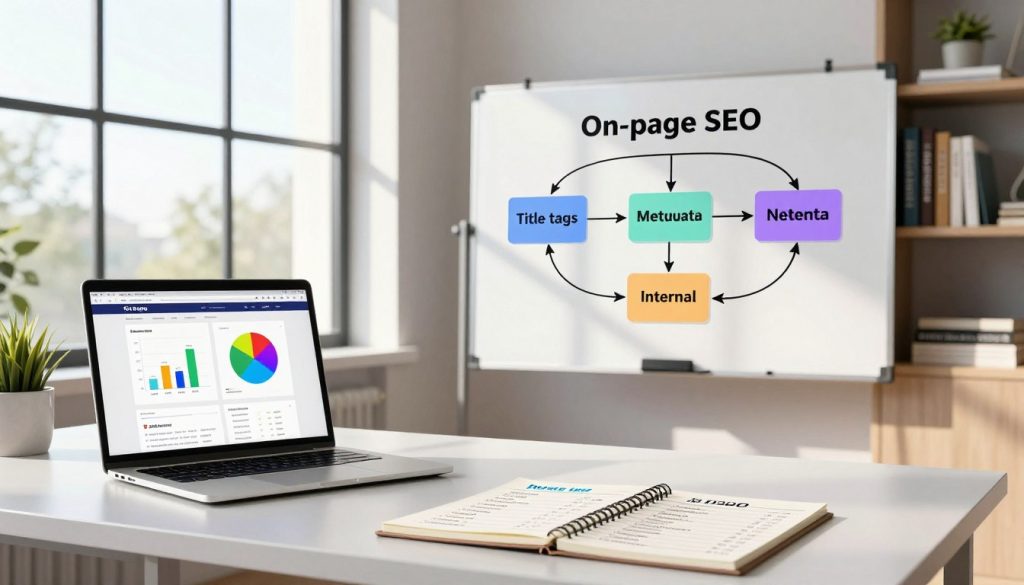
Your website’s visibility on search engines depends on good on-page SEO. This means making sure your site is optimized for better rankings. You need to tweak various elements on your website to achieve top organic rankings.
Optimizing Title Tags and Meta Descriptions
Title tags and meta descriptions are key for SEO. They’re the first thing users and search engines see. A good title tag should be short, descriptive, and include your main keyword.
For example, if you’re targeting “on-page SEO,” your title tag could be “Mastering On-Page SEO: Techniques for Better Rankings.”
Meta descriptions give a quick summary of your page’s content. They should grab users’ attention and include relevant keywords. Keep your meta description between 150-160 characters.
| Element | Best Practice | Example |
|---|---|---|
| Title Tag | Include primary keyword, be concise | Mastering On-Page SEO: Techniques |
| Meta Description | Summarize page content, include keywords | Learn how to optimize your website with our on-page SEO techniques for top rankings. |
Importance of Header Tags
Header tags (H1, H2, H3, etc.) are more than just formatting. They’re vital for SEO. The H1 tag is for the page title, and H2 and H3 for subheadings.
Using header tags well makes your content easier to read and understand. Make sure your H1 tag has your main keyword. Use H2 and H3 tags to organize your content.
Quality Content Creation
Creating quality content is essential for SEO success. It’s not just about keywords. It’s about making content that’s valuable, informative, and engaging.
To make quality content, focus on:
- Understanding your audience’s needs and pain points
- Providing detailed and well-researched information
- Writing in a conversational tone that keeps readers interested
- Using keywords naturally
By doing these things, you create content that ranks well and offers value to your readers. This encourages them to spend more time on your website.
Off-Page SEO Strategies to Boost Rankings
To improve your website’s rankings, you need a strong off-page SEO strategy. It’s not just about tweaking your site. You must build your site’s credibility and authority online.
Off-page SEO helps build your site’s reputation. It involves getting high-quality backlinks and using social media well. It’s not just about being online. It’s about being influential.
Building Quality Backlinks
Backlinks are key because they show search engines your content is valuable. But, not all backlinks are the same.
Quality over Quantity: Aim for backlinks from authoritative sites in your niche. One good backlink is worth more than many bad ones.
- Guest blogging on reputable sites
- Participating in industry-specific forums and discussions
- Creating shareable, high-quality content that naturally attracts links
Here’s a comparison of different backlink sources:
| Backlink Source | Quality | Impact on Rankings |
|---|---|---|
| Industry-specific blogs | High | Significant |
| Local business directories | Medium | Moderate |
| Low-quality sites | Low | Negative |
Utilizing Social Media for SEO
Social media is more than just for chatting. It’s a great tool for boosting your SEO. By sharing your content, you can draw more traffic to your site and boost your visibility online.
Engage and Share: Get your followers to share your content. The more shares, the better chance of getting backlinks and improving rankings.
To make the most of social media, create content that grabs your audience’s attention. Use the right hashtags, tag influencers, and join online chats.
Technical SEO and Its Impact on Rankings
To boost your website’s search engine rankings, focus on technical SEO. It’s the unseen work that can make or break your online presence.
Let’s explore two key technical SEO areas: site speed and mobile responsiveness. These are not just minor details. They are essential for your website’s visibility and usability.
Site Speed and Its Importance
Site speed is now a must, not just a nice-to-have. A slow site can annoy users, increase bounce rates, and hurt your rankings. Aim for a site that loads in under 3 seconds to keep users and search engines happy.
Here are some tips to speed up your site:
- Optimize images to reduce file size without losing quality.
- Minify CSS, JavaScript, and HTML to lessen code load.
- Use browser caching to store resources locally.
- Employ a Content Delivery Network (CDN) to distribute content worldwide.
| Optimization Technique | Impact on Site Speed |
|---|---|
| Image Optimization | Reduces file size, improving load times |
| Minification of Code | Decreases data transfer |
| Browser Caching | Stores resources locally, reducing repeat load times |
Mobile Responsiveness Best Practices
Mobile responsiveness is now essential, not optional. With most users accessing websites on mobile, a responsive design ensures your site works well on all devices.
To achieve mobile responsiveness, focus on:
- Using flexible grids that adapt to different screen sizes.
- Implementing media queries for different styles based on device characteristics.
- Making content easy to read and navigate on smaller screens.
By focusing on site speed and mobile responsiveness, you improve user experience and boost your rankings. Remember, technical SEO is an ongoing effort that needs regular checks and updates to stay competitive.
User Experience (UX) and Rankings
User experience is key to your website’s search engine rankings. I’ve seen many clients improve their rankings by focusing on UX. It’s not just about looks; it’s about making the experience smooth and engaging.
Importance of Site Navigation
Good site navigation is vital for a great user experience. It lets users find what they need fast. Make sure your website’s menu is easy to use, with clear categories and no clutter. Here are some tips to improve navigation:
- Simplify your menu structure
- Use descriptive labels for your menu items
- Implement a search function to help users find specific content
By making your site easy to navigate, you’ll keep users interested and lower bounce rates.

Reducing Bounce Rates for Better Rankings
Bounce rate shows how engaging your website is. A high bounce rate can hurt your rankings, as it means your site isn’t giving users what they need. To lower bounce rates, create high-quality, relevant content that meets your audience’s needs.
Some effective strategies include:
- Improving page load times to reduce frustration
- Ensuring your content is mobile-friendly
- Using compelling headlines and introductions to draw users in
By using these strategies, you can boost user engagement and improve your website’s rankings.
Content Marketing for Higher Rankings
Content marketing is key to any successful SEO plan. It directly affects your keyword rankings. To rank high, you need a strategy that targets the right keywords and engages your audience.
Blogging as a Ranking Strategy
Blogging is a strong tool in your SEO toolkit. By posting high-quality, keyword-rich content regularly, you can boost your site’s visibility. Here’s how blogging can help your rankings:
- Targets specific keywords and phrases your audience is searching for
- Provides fresh content that search engines favor
- Establishes your authority in your niche
To make blogging work for your rankings, create content that’s both informative and engaging. Use a mix of short-tail and long-tail keywords to attract more people.
Engaging Multimedia Content
Adding multimedia content like videos, infographics, and podcasts can boost your SEO. Multimedia content can:
- Increase user engagement and reduce bounce rates
- Provide additional opportunities for keyword optimization
- Improve your site’s overall user experience
Here’s a comparison of different types of multimedia content and their SEO impact:
| Content Type | SEO Benefit | User Engagement |
|---|---|---|
| Videos | High | Very High |
| Infographics | Medium | High |
| Podcasts | Medium | High |
By using these content strategies, you can boost your site’s rankings and attract more visitors. The goal is to create content that your audience loves and is good for search engines.
Local SEO: Targeting Local Rankings
If you run a business that needs local customers, you can’t ignore local SEO. I’ll show you how to make your online presence better. This will help you attract more local customers and get higher rankings.
Local SEO helps you be seen by the right people. It’s not just about being on Google. It’s about being found by the right people at the right time.
Google My Business Optimization
Optimizing your Google My Business (GMB) listing is key in local SEO. Your GMB profile is often the first thing people see. So, make it count.
- Claim and verify your GMB listing to ensure you have control over the information displayed.
- Complete your profile with accurate and up-to-date information, including your business hours, address, and phone number.
- Use high-quality images that showcase your business, products, and services.
Google says businesses with complete GMB profiles are more likely to be in search results. So, keep your info accurate and fresh.
“The most successful businesses are those that understand the importance of local SEO and take proactive steps to optimize their online presence.”
Local Keywords and Their Importance
Using local keywords is key to getting local search traffic. These keywords include your city, state, or region. They help search engines see your business is local.
| Keyword Type | Example | Importance |
|---|---|---|
| Local Keyword | “New York coffee shop” | High |
| Long-Tail Local Keyword | “Best coffee shop in Manhattan” | Very High |
Long-tail local keywords, like “Best coffee shop in Manhattan,” are great. They’re less competitive and more specific. They attract customers who are ready to buy.
By focusing on local SEO, optimizing your Google My Business listing, and using local keywords well, you can improve your local search rankings. This will help you attract more local customers.
Monitoring and Analyzing Rankings
Boosting your SEO rankings starts with constant monitoring and analysis. You can’t ignore how your website ranks in search engines.
Tools for Tracking SEO Performance
To track your SEO rankings, you need the right tools. Google Analytics and Google Search Console are key for understanding your site’s traffic and search engine interactions. Tools like Ahrefs, SEMrush, and Moz also provide detailed SEO audits and tracking.
These tools show you where to improve, track keyword rankings, and compare with competitors. Using these insights, you can tweak your SEO strategy to move up the rankings.
Importance of Regular Audits
Regular SEO audits are vital for keeping and boosting your rankings. An audit spots technical issues, content gaps, and link building chances. It’s about fixing problems and grabbing opportunities to better your SEO.
By doing regular audits, you keep up with algorithm changes, adjust your plan, and keep your site search engine friendly. This active approach is essential for keeping and improving your SEO rankings over time.
Staying Updated with Ranking Algorithms
Keeping up with the latest ranking algorithm updates is key for better search engine rankings. The SEO world is always changing. It’s important to stay informed to keep your online presence strong.
Search engines like Google update their algorithms often. They do this to give users the best content. These updates can greatly affect your website’s visibility. So, it’s vital to stay ahead.
Major Algorithm Updates to Watch
Some big algorithm updates include:
- Google’s BERT update, which made the search engine better at understanding natural language
- The Mobile-First Indexing update, which made mobile-friendly websites more important
- The Core Web Vitals update, which focused on page experience and user experience
These updates show how search engine algorithms keep evolving. They highlight the need for flexibility in your SEO plan.
Adapting to Changes in SEO Trends
To improve rankings, you need to adjust your SEO strategy with algorithm updates. This might mean:
| SEO Strategy | Adaptation |
|---|---|
| Content Creation | Focus on high-quality, relevant, and engaging content |
| Technical SEO | Make sure your website is mobile-friendly and loads quickly |
| User Experience | Work on better site navigation and lower bounce rates |
By keeping up with the latest SEO trends and adapting, you can keep and boost your website’s search engine rankings.
Importance of User Engagement in Rankings
User engagement is key to getting high rankings on search engines. When users interact well with your site, search engines see it as quality. This boosts your site’s ranking.
Metrics That Matter: Click-Through Rates
Click-through rate (CTR) shows how good your website’s title tags and meta descriptions are. A high CTR means your content matches the search query well. It makes users want to visit your site.
To get a better CTR, make sure your title tags are catchy. Your meta descriptions should clearly sum up your content. This encourages users to click.
Encouraging User Interaction
To increase user engagement, create content that speaks to your audience. Use interactive elements like quizzes, polls, and multimedia to keep users interested.
Adding videos or infographics can greatly improve user experience. These elements make your content more engaging and valuable to users.
By focusing on user engagement and optimizing your content, you can boost your website’s rankings. This will also drive more traffic to your site.
Future Trends in Search Rankings
The world of search engine rankings is always changing. Two big trends are on the rise: AI’s growing role and the growth of voice search.
Artificial Intelligence Takes Center Stage
AI is changing how search engines rank websites. AI algorithms can now understand the context and intent of search queries better. To keep up, focus on creating high-quality, relevant content that meets user needs.
Optimizing for Voice Search
Voice search is getting more popular. To rank well in voice search, use natural language and long-tail keywords in your content. This will help you stay ahead in SEO rankings.